
Why Clean Your Roof?
Four good reasons, beyond how it looks from the street.
Appearance
A clean roof makes a Sandbach house look cared for, and it's the first thing a buyer or a surveyor notices. Moss, black algae streaks and lichen make a sound roof look like it needs replacing.
Protecting Your Tiles
Moss holds water, water freezes, and frost spalls the surface off concrete and clay tiles. Moss roots also work into the tile surface and under the laps. Cleaning it off adds years to the tiles.
Preventing Blockages
Every clump of moss that comes off the roof in a storm ends up in the gutter or the valley. Blocked gutters overflow and rot the fascia; blocked valleys back water up under the slates.
Avoiding Moisture Problems
A roof covered in moss stays wet for days after rain, which keeps the battens and membrane damp from above and encourages the kind of slow rot that only shows when the roof is stripped.
Cleaning shows up what moss was hiding, so we check the roof as we go and quote any repairs before treating it. Moss washed down blocks the gutters, which we clear at the end. A concrete tile roof can be sealed and recoloured afterwards with roof painting.
Our Cleaning Process
Six steps, in order, on every roof we clean in Sandbach, CW11.
Survey
We check the covering, the condition of the tiles and the state of the ridges and flashings before we start. A roof that's already fragile needs a gentler approach, and we'll tell you if cleaning isn't the right thing to do.
Safety Setup
Scaffold, towers or roof ladders as the roof demands, with edge protection. Nobody works off a ladder on a wet, mossy roof.
Moss Removal
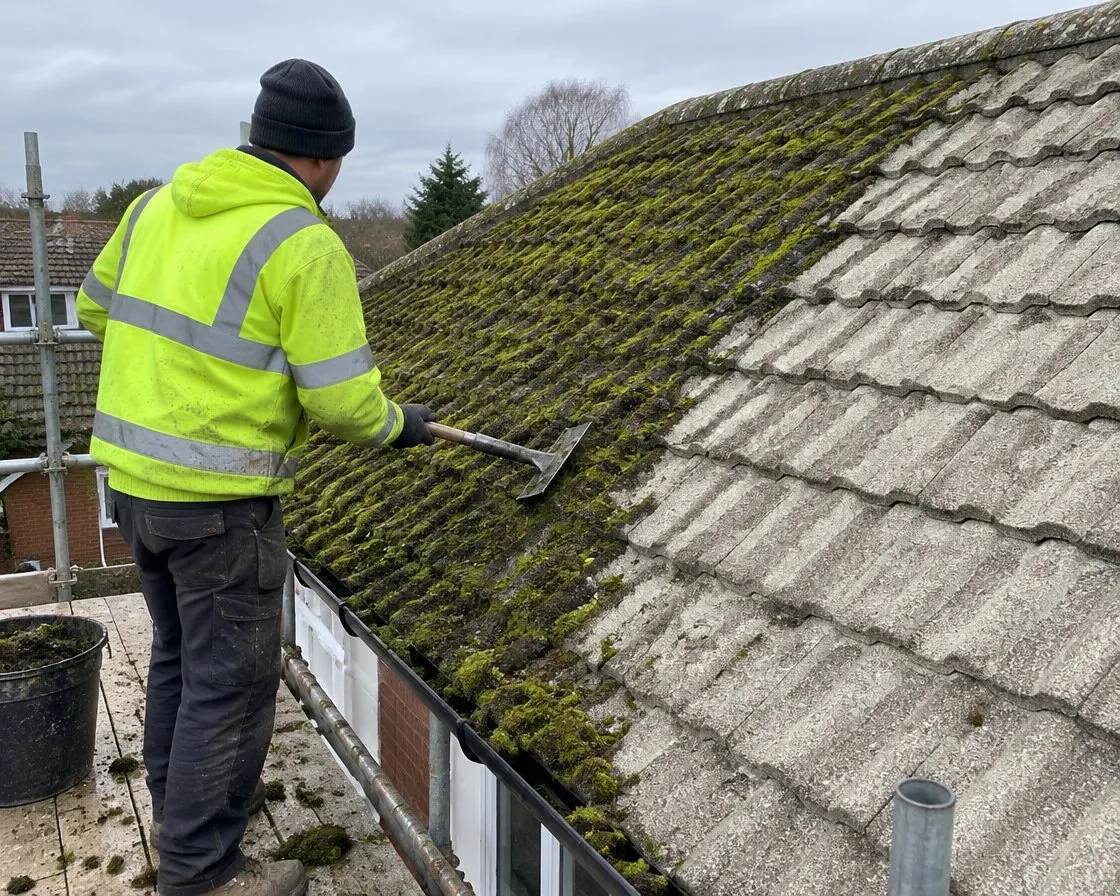
Thick moss is scraped off by hand with purpose-made tools, working with the lap of the tiles so nothing is lifted or dislodged. It's slower than a pressure washer and it's why the tiles survive.
Cleaning
The roof is then washed with a soft-wash or controlled low-pressure system to remove the remaining growth and dirt without disturbing the tile surface or driving water under the laps.
Biocide Treatment
A fungicidal treatment is applied to the clean roof and left to work. It kills the spores in the surface so the moss doesn't simply grow back the following spring, and it's the step that makes the difference between a clean that lasts and one that doesn't.
Gutter Clear
Everything that came off the roof is cleared from the gutters and valleys, the downpipes are flushed, and the debris goes in our van, not your garden.
What We Don't Do
We don't pressure-wash roofs. High-pressure water strips the protective surface off concrete tiles, blasts the pigment out of coloured ones, forces water under the laps and into the loft, and can shift tiles and ridge mortar. We've been called to several Sandbach roofs that leaked for the first time the week after a pressure-wash. We also don't walk on fragile roofs, don't clean in freezing weather, and don't use chemicals that run off into gardens or drains uncontrolled.
Types of Roof Growth
Three things grow on Sandbach roofs, and they need slightly different handling.
Moss
Thick green cushions on north slopes, under trees and along the lower courses. The one that does the damage, and the one that has to be removed by hand before anything else.
Algae
The black and green streaks that run down slopes and make a roof look dirty. Harmless to the tiles but unsightly; it responds well to soft-washing and biocide.
Lichen
Grey, white and orange crusts that bond to the tile surface. Hard to remove without damage; we treat it with biocide and let it die back and weather off rather than scraping it.
After Cleaning
A cleaned and treated roof in Sandbach typically stays clear for three to five years, longer on sunny slopes and shorter under trees. The biocide keeps working in the surface for a season or more. If you want the colour back as well as the moss gone, a roof coating after cleaning seals the tiles and restores the finish. And if the clean has shown up cracked tiles or failed mortar, we'll tell you and quote for the repairs, because a clean roof is a good moment to fix them.